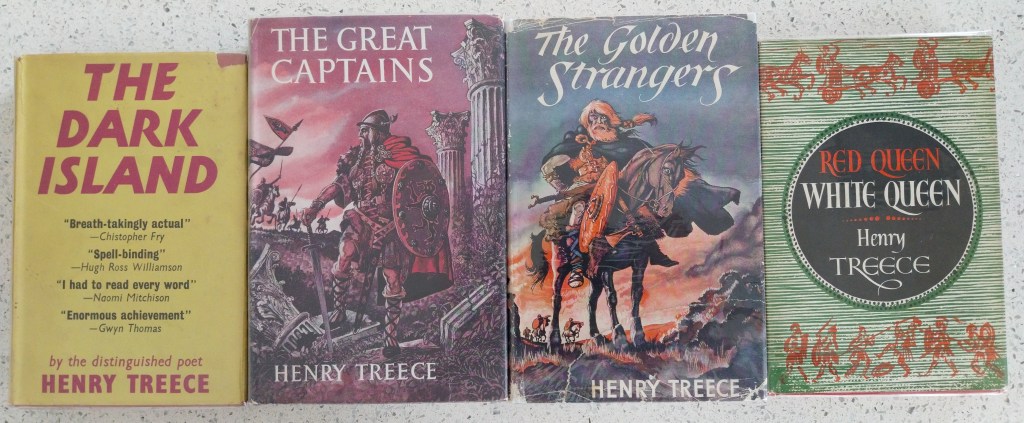
In the first post on this blog I discussed how I had come (back) to Henry Treece via the unexpected discovery of his Celtic Tetralogy, which was re-issued by the publishers Savoy in the 1980s. This sequence of historical novels is slightly unusual in that the order in which the books were published is not the same as the order in which their stories unfold in time.
The first book to appear (and indeed Treece’s first novel) was The Dark Island in 1952. Then, in 1956, came both The Golden Strangers and The Great Captains. It was another two years before Red Queen, White Queen followed in 1958. You can see the order of publication, based on the copies in my own collection, in the image above.
Read chronologically, however the sequence runs from The Golden Strangers, about the coming of the Celts to Britain, through The Dark Island, centred on Caratacus and the Roman invasion, then Red Queen, White Queen, which revisits Roman Britain through the rising of Boudicca, and finally The Great Captains, Treece’s stripped-down, post-Roman Arthurian novel. Like this:
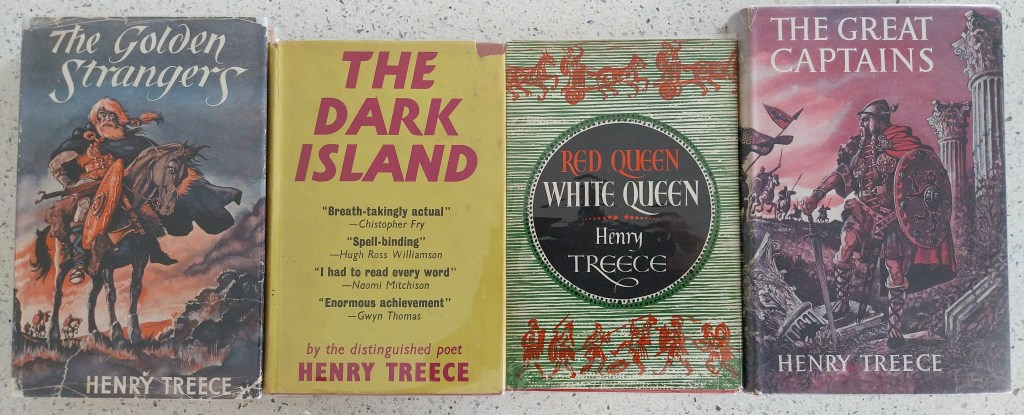
So Treece did not build the tetralogy in neat historical progression; he assembled it more obliquely, moving backwards into pre-Roman Britain and forwards into Arthurian Britain only after beginning in the thick of Rome’s collision with the native peoples of the islands.
That mismatch tells us something about Treece as a novelist. He was less interested in writing a tidy sequence than in exploring a long age of cultural conflict: invasion, resistance, collapse and reinvention. The books gain extra force when read in historical order, but their publication order shows how Treece discovered this imagined Britain in fragments, circling around the great breaks in its story rather than marching through them step by step. Indeed, his second novel, The Rebels (1953), which I will deal with in a later post, is set in the 19th century.
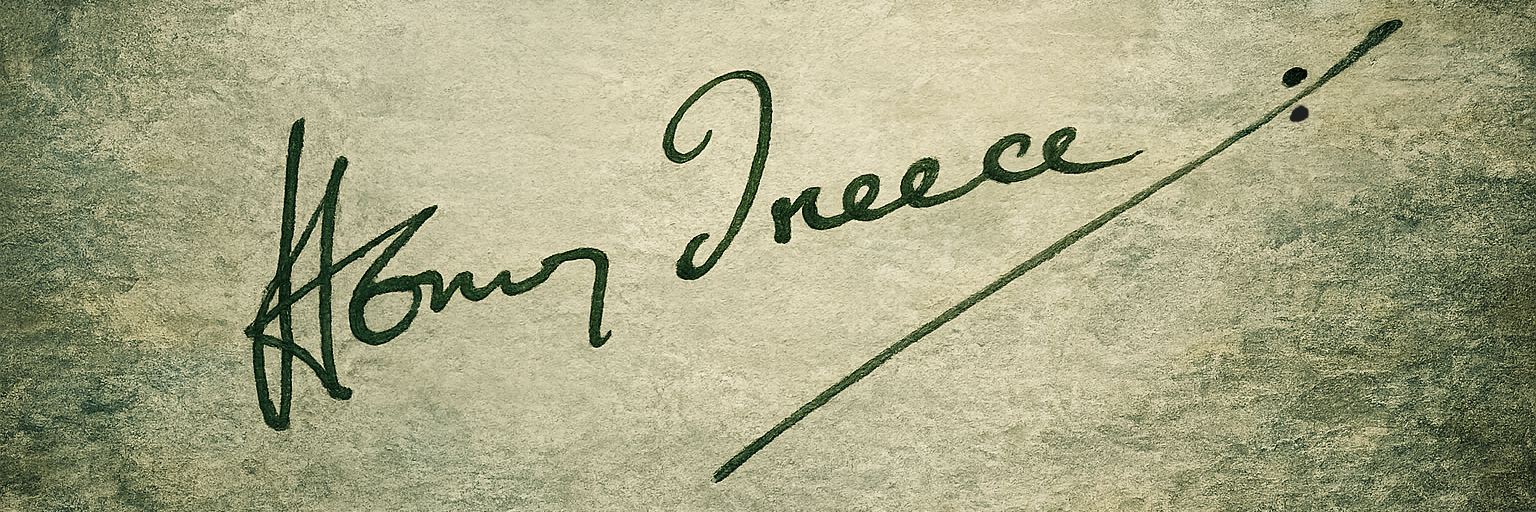
Those copies from my own collection are all first editions, though they vary in their condition, especially the dust jackets. Only one of them – The Dark Island – is signed:
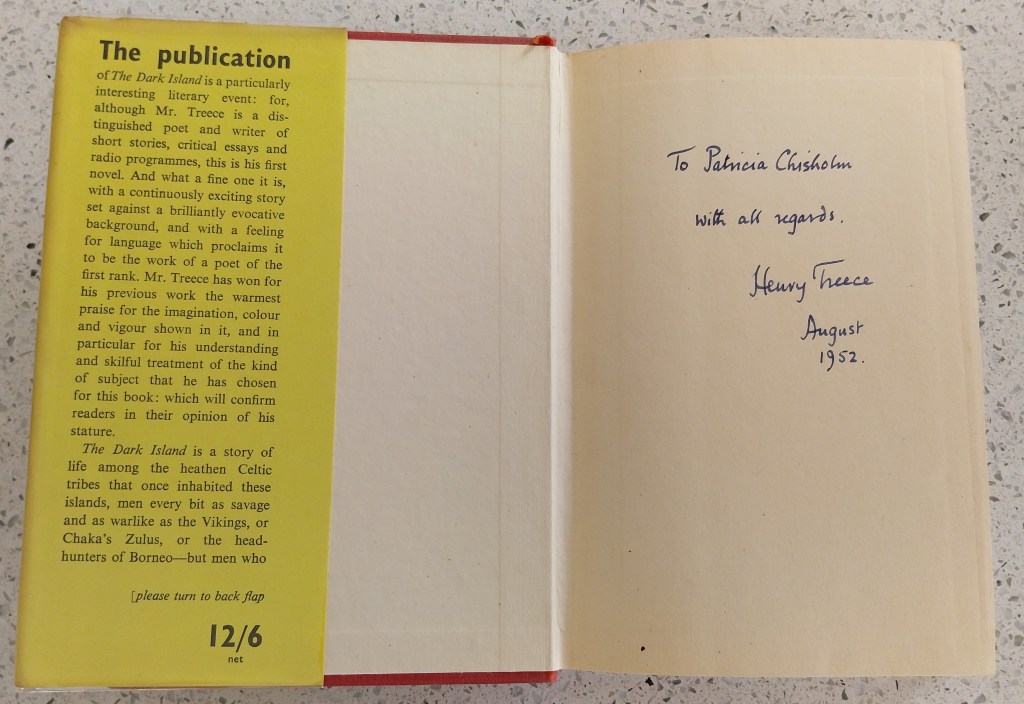
I’ve not been able to track down the Patricia Chisholm to whom the book was inscribed – she’s certainly not an obvious literary figure. She may well have been a private acquaintance of Treece’s, quite possibly from his Humber/Lincolnshire circle. A quick search of online newspapers suggests that The Dark Island was published in the summer of that year, so this is an early signature.
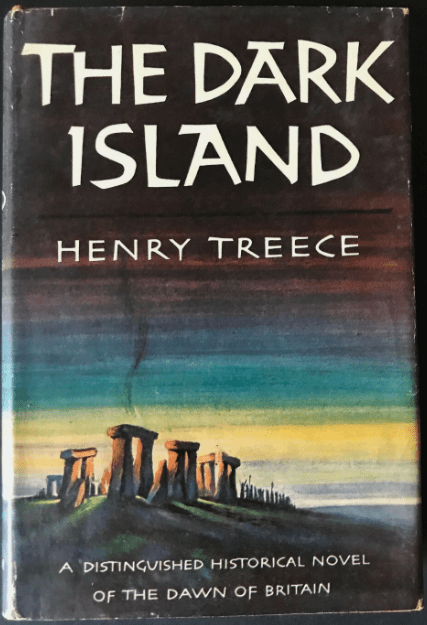
Signed copies of Treece’s first novel are relatively rare – I’ve not seen one listed on AbeBooks for some time, and when they do appear they command relatively high prices (£100+). The American edition of The Dark Island appeared in 1953 and it has a much nicer cover than the British version, with it’s standardised Gollancz-Yellow dust jacket:
Regardless of the order that you read them in (and they are all stand-alone novels) the Celtic Tetralogy is a fine series of books dealing with a fascinating period in British history.
 henry treece