For those of us who were born in the 1960s, the name Henry Treece is a familiar one, even if, with the passage of time, we have forgotten it. Treece’s historical children’s novels regularly featured on junior school reading lists and in the offerings of book clubs such as the Puffin Club. That’s certainly how I first encountered this most British of writers, through an enjoyment of his Viking Trilogy – Viking’s Dawn, The Road to Miklagard, and Viking’s Sunset – three of the best books of the genre ever written, in my opinion.
As I grew older, these stories, and Treece’s name, faded from my memory, occasionally recalled as half-remembered fragments of school reading or the viking stories being a gateway into more adult books by Tolkien and Howard. Until one day, in the 1980s, I unexpectedly encountered Treece again, juxtaposed with one of my favourite fantasy authors, Michael Moorcock.
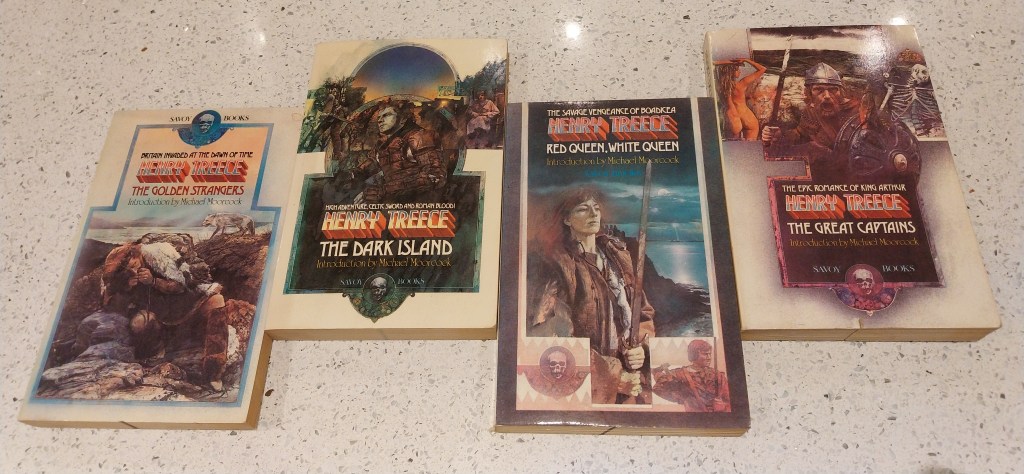
Moorcock had provided the introductions to new editions of four of Treece’s novels – his Celtic Tetralogy – published by Savoy Books. They are shown in the photo above and I’ll write a longer post about these in the future. For now it’s enough to know that I spotted them in the remainders pile in the book section of a local department store. Picking them up I was confused. These were not short, lightly framed stories for children, they were long, densely conceived adult novels. It was a revelation! I had no idea that Treece wrote for grown ups. I bought all four books, took them home, and read them.
So began my journey back to Henry Treece. Indeed, it was the start of a bit of an obsession with collecting his books and other publications. Forty years of collecting later it’s time to share this passion for Treece’s work, and the collection that I’ve accumulated over the years, with a wider audience. Because Henry Treece is, I feel, one of our most neglected writers. He’s remembered, if he’s recalled at all, as primarily a writer of fiction for kids. But there was so much more to him than that as I plan to show on this blog. As well as showcasing my own collection I’ll highlight the breadth of his work and how Treece influenced both his contemporaries and later authors.
If you’re a fan or a collector of Henry Treece I’d love to hear from you – comments are open, please do leave your thoughts. For now, though, I’ll leave the last word to Henry Treece himself, from his 1946 volume How I See Apocalypse, who defined himself as a writer:
“…who senses the chaos, the turbulence, the laughter, and the tears, the order and the peace of the world in its entirety…”
 henry treece