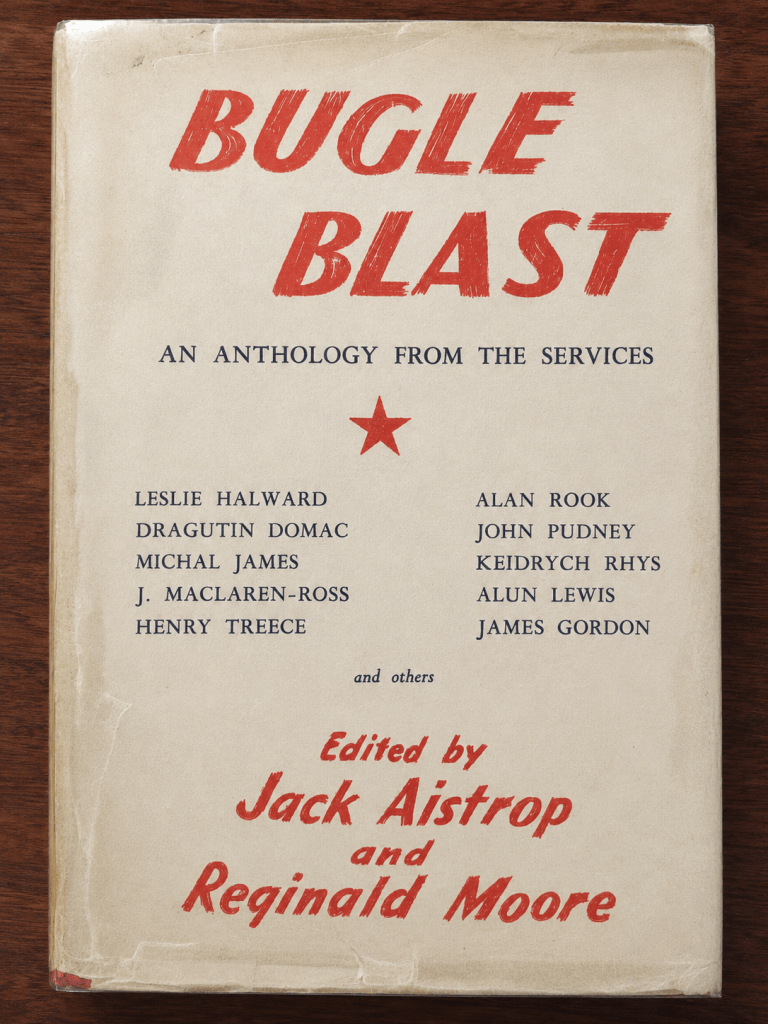
One of the pleasures of collecting Henry Treece is the constant probability of unearthing obscure material in published collections, a sort of anthology archaeology if you will. Whenever I browse second hand bookshops I make a point of checking poetry collections and compilations of children’s stories, just in case there’s a Treece contribution to be discovered. Most of the the time there’s not, of course, but just occasionally my stomach flips and a sale is assured. In this post I present an example from my collection, which led me in a bibliographic direction I had not anticipated.
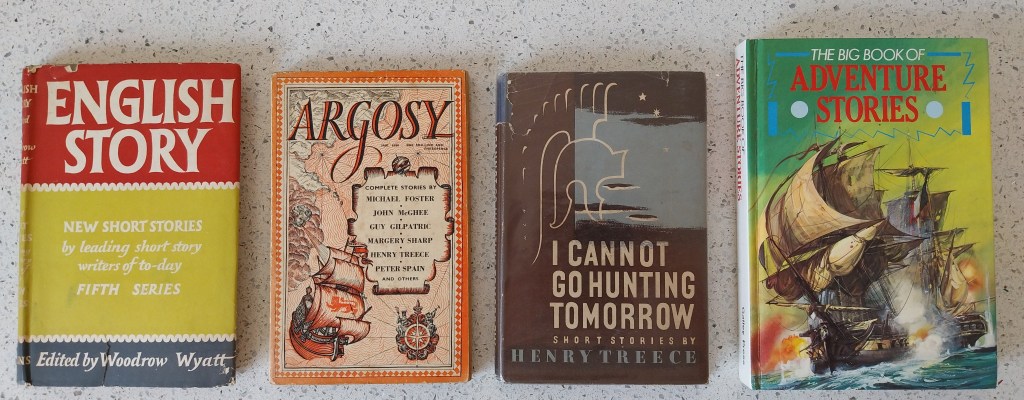
This archaeology begins with The Big Book of Adventure Stories, published by Hamlyn for Galley Press in 1986, which I picked up in a charity shop some years ago. With its brightly coloured cover of sailing ships firing broadsides at one another, it looks exactly like the sort of book that might once have appeared under a Christmas tree for an adventure-hungry child. The 1986 volume appears to have been the last in a long-lived sequence of repackagings of earlier anthologies originally edited by Eric Duthie.
The first story in the collection is Treece’s “The Visitor”, which initially entered this particular publishing stream in Mystery and Adventure Stories for Boys (Odhams, 1962); material from that and Duthie’s Open-Air Adventure Stories for Boys (1965) was subsequently brought together in the much larger Big Book of Boys’ Adventure Stories (Hamlyn, 1977). The 1986 Galley Press volume was another, shorter selection from this material, with its copyright page explicitly recording 1962, 1965 and 1977 before giving 1986 as the date of the new edition. I have so far found no later edition in this particular sequence.
Reading “The Visitor” in this book I was struck by its rather bizarre setting and violent themes (more of which later) plus some internal inconsistencies in the writing and a weak ending. It turns out that these were caused by this children’s story being a heavily edited version of a story originally for adults that had been substantially rewritten for younger readers
As far as I have been able to determine, there were four printings of “The Visitor”:
- Its first appearance in a prose anthology called English Story: Fifth Series in 1944;
- A reprinting in the magazine Argosy in January 1946;
- It then turns up in Treece’s first prose collection I Cannot Go Hunting Tomorrow, also in 1946;
- Finally, the version published in Mystery and Adventure Stories for Boys in 1962, which was later recycled into the 1986 volume.
The first three of these occurrences are essentially the same story. There are small differences of punctuation and presentation, but the text remains remarkably stable. Then, in 1962, something dramatic happens. The basic plot remains intact: A teenage boy is left alone to look after the family farm while everybody else goes to market. Enjoying the responsibility, and sneaking a cigarette, he is suddenly confronted by a strange old man who forces his way into the farmhouse.
The visitor is a wonderfully unpleasant Treece creation: filthy, emaciated, unpredictable and repeatedly described in animal terms. There’s also a suggestion that he may in fact belong to a different time and place, in his archaic language and his rejection of paper currency and a demand for gold coins. He produces a homemade knife, demands food and money, terrorises the boy and orders him onto his knees. Eventually the boy knocks him down, but when he returns with water the old man has disappeared.
Even in the children’s version this is pretty dark stuff. But the original goes considerably further.
Some of the changes made in 1962 are simple sanitising. “Young swine” becomes “young brat”; “Damn you” becomes “Blast you”; and “God, how safe I felt!” becomes the rather more respectable “Heavens, how safe I felt!” The violence is also toned down. In the original, the boy stamps on the old man with his “heavy, steel-shod farm boots” and feels the metal tip grate against his shinbone. That detail disappears.
More strikingly, the visitor’s homemade knife loses some of its personality. In the original he proudly calls it a “belly-slitter, a real gut-nicker” and talks enthusiastically about “nice necks” opening under its blade. In the children’s version the knife remains, because the story needs it, but much of the sadistic relish has gone.
The biggest change, though, concerns Elsie Hodgson, the family’s “day-girl”. In the original story she is mentioned while the frightened boy imagines who might return to the farm and rescue him. Later, the visitor notices a flowered cotton overall belonging to her and becomes interested. The old man then launches into a distinctly disturbing fantasy about what a “nice girl” Elsie must be, the flowers she wears, and that she must be “A nice bit of girl for taking in the hay”.
At first this seems merely another part of his grotesque rambling, but its significance becomes clear only at the end. The following morning the boy goes with his father to the police station, carrying the visitor’s knife wrapped in brown paper. It has been found in the barn, covered in blood, beside Elsie Hodgson, “whose head was almost severed from her poor naked body.” And that is where the original story ends.
It is a brutal piece of writing, particularly because Treece has prepared us for it without making the connection explicit. The old man’s fascination with knives and necks, his interest in Elsie, and his strange mixture of sexual and violent imagery suddenly acquire a much darker meaning.
This sadistic darkness is already there in the very first version of the story in 1944, Argosy printed it unchanged in 1946, and Treece retained it when he collected the story later that year. But it could hardly survive in a boys’ adventure anthology. In the 1962 version Elsie effectively disappears. The earlier references to her are removed, as is the old man’s disturbing interest in the day-girl, and because Elsie has gone, the ending has to be rewritten completely. Instead of the boy carrying a blood-covered knife to the police station after Elsie’s murder, the Inspector produces the knife himself and tells him: “Another was not so lucky.”
The story then ends with a completely new sentence: “There was no more jeering at home”, referring to the fact that the boy’s family were sceptical of his account.
It is a fascinating shift, in which a rather nasty adult horror story has been turned into something much closer to a conventional children’s adventure: frightening things happen, the hero survives, and in the end the adults have to admit that he was telling the truth. What I find particularly interesting is that the 1944–46 text was so stable. Treece himself does not appear to have gradually softened or reshaped the story. For nearly twenty years “The Visitor” existed as a piece of adult fiction, complete with the swearing, the “gut-nicker”, the sexual menace and Elsie’s almost decapitated naked body. Only when it entered the world of children’s publishing did all of that disappear.
Whether Treece himself made the alterations for the 1962 anthology, or whether the editor Eric Duthie or somebody at Odhams did the work, I don’t yet know. But somebody went through the story very deliberately, deciding what could stay and what could not. Menace was acceptable. Violence, within limits, was acceptable. The knife could stay. The boy could still be forced onto his knees to kiss the old man’s feet. But the sexual threat, the sadistic language and Elsie Hodgson had to go.
By 1962, Treece was starting to become much better known as a writer of children’s stories and so this adaptation of an adult story is not so surprising. However, as far as I know “The Visitor” was a one-off and I am not aware of any other adaptations. But who knows – some additional anthology archaeology may turn up more examples.