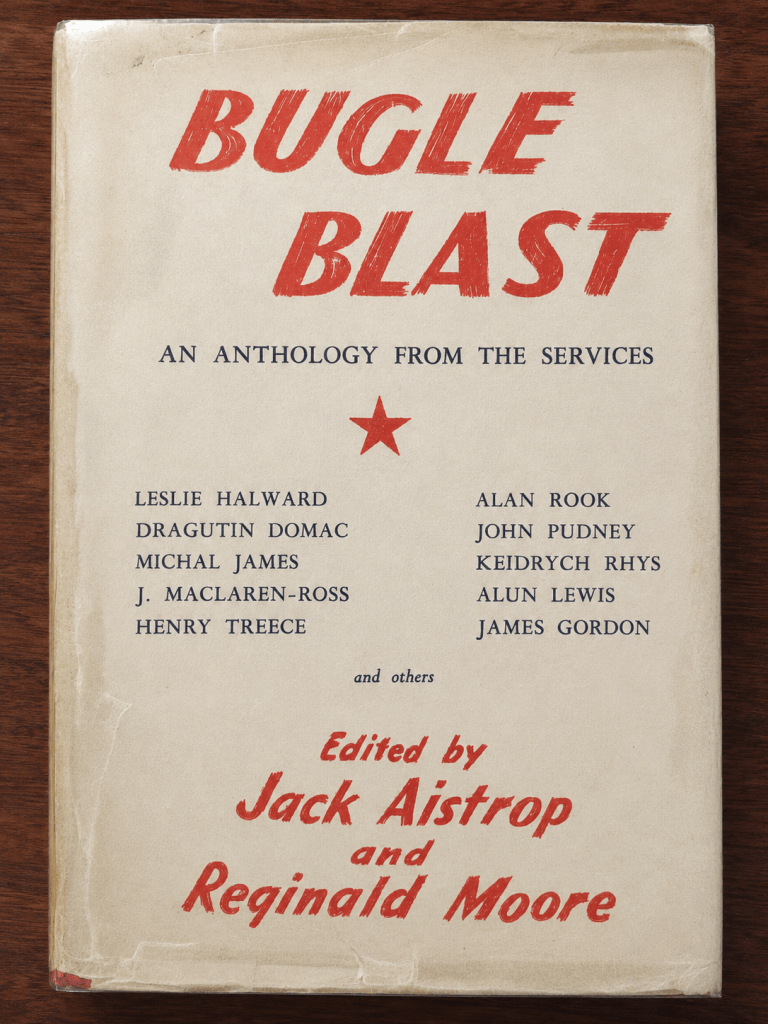
Another small gap in my Treece collection has been filled, this time with a rather nice copy of Bugle Blast: An Anthology from the Services, edited by Jack Aistrop and Reginald Moore and published by George Allen & Unwin in 1943. It was the first of what eventually became four Bugle Blast anthologies published between 1943 and 1947, though this is the only one in which Treece appears.
My copy retains its wonderfully austere red-and-grey dust wrapper, very obviously a product of wartime publishing, covering stiff boards that mirror the front of the wrapper, though the back board remains plain. The verso of the title page carries the familiar lion-and-book symbol announcing that its paper and binding conform to the Book Production War Economy Standard. It was printed by W. S. Cowell of Ipswich and London.
The idea behind Bugle Blast was to showcase imaginative writing emerging from the armed forces. Although almost all of the 23 contributors were servicemen, the publishers explicitly intended the series to provide an opening for young women in the forces too. Michal James was the sole woman represented in this first volume, according to a contemporary advertisement for the book in the anthology Million – New Left Writing. The dust wrapper explains that the editors were interested less in straightforward reportage of the war than in the imaginative writing emerging from it, and hoped that the volume might encourage younger servicemen to continue writing. The contributors were given considerable freedom: as the editors put it, rather nicely, “they wrote as they pleased.” Treece, as we will see, seems to have taken this to heart.
Treece was in interesting company. Among the 23 contributors were Alun Lewis, Sidney Keyes, John Pudney (with whom Treece later collaborated as co-editors), Jocelyn Brooke, Julian Maclaren-Ross (who deserted from the army the year that Bugle Blast was published), and Woodrow Wyatt. I’ve not been able to find any biographical information about Michal James – her contribution, the rather dark short story “Out-Patients Only”, seems to be all that remains of her published work. If anyone can tell me more about her, please leave a comment below.
At this time, Treece was serving as an intelligence officer in the RAF. His contribution, “The Conscripts”, occupies pages 93–95 and opens the section rather oddly entitled “Singing & Surveying”. This short poem is very recognisably Treece at this stage of his career. Published only a year after his Faber collection Invitation and Warning (1942), it mixes physical violence and despair with the startling natural imagery that runs through so much of his early poetry. There are rabbits, peonies, hyacinths, a lark and, most strikingly, a cherry tree that bends down towards the suffering soldier and promises that fruit will eventually follow blossom despite everything that birds and men may do to it.
The final section moves into something more visionary and characteristically Apocalyptic: the damaged young men of the war become almost mythological figures, simultaneously glorious and despairing, the living and dead merging together. It is not understated poetry, but understatement was hardly the point of the New Apocalypse.
One line is particularly arresting in a poem published by a serving officer in 1943. The wounded conscript asks, “Why must I suffer for a nation’s lies?” Seen in the context of Treece’s later anarchist sympathies, this seems more than conventional wartime disillusionment and reflects a deeper suspicion of nationalism, authority and the claims made by states upon individuals. Yet the poem is not simply anti-war and in later lines Treece remains capable of celebrating the courage and sacrifice of the conscripts themselves. The distinction between the nobility of the individual and the questionable causes imposed upon them is an important one and Treece returned to this theme time and again.
What particularly appeals to me about books such as this is that they put Treece back into his original literary context. Long before The Dark Island, the Viking books and the historical novels for which he is now chiefly remembered, he was a wartime poet appearing alongside some of the most interesting young British writers of his generation. Bugle Blast is a modest little book, printed on economy paper in the middle of a war, but it well captures such a vital time in British history and culture. Needless to say, I’m pleased to have found a copy with its dust wrapper still intact, albeit price-clipped.
As far as I know, “The Conscripts” does not appear in any of Treece’s poetry collections and has not otherwise been re-printed since it appeared in 1943. Below is the whole poem, assembled into a single page using AI.


